
 The B2B digital solutions specialist
Most businesses are already using WhatsApp. They just aren’t using it deliberately.
It crept in through the back door. A sales rep set up a group with a few of their bigger accounts. A depot manager started sending delivery photos to customers from his own phone. Somebody in the office answered a query on WhatsApp because that’s where the customer asked it. None of this was planned, none of it was measured, and almost none of it was paid for.
What’s changing now is that WhatsApp is being considered as a strategic tool: something that sits across the whole business, from how your employees communicate with each other, to how your customers reach you, to how you reach them. And the moment something becomes strategic, the finance director asks the obvious question. What’s the return?
That’s a fair question. It’s also one that most businesses haven’t yet had to answer properly, because until recently the case for WhatsApp didn’t need one.
The businesses that moved first didn’t build a detailed ROI model. They didn’t need to. The read rates on WhatsApp are so far ahead of SMS and email that the comparison barely feels fair, and they could see that nearly every one of their customers was already using it privately, every day. Putting the two together felt like a fairly non-controversial decision: here is a channel with enormous scale and unusually high engagement, and our customers are already on it. Let’s use it.
That instinct was right. But “the general stats look good” is not an ROI case, and it won’t carry a business through a proper investment decision. We are now moving rapidly from “this is probably a good idea” to two much sharper questions:
The first question is reasonably easy to answer. The second is where it gets interesting, because the answer depends entirely on what you decide to do with the channel once you have it.

Here’s the thing that is easy to miss. WhatsApp isn’t one use case. It’s a channel, and the versatility of it is the whole point.
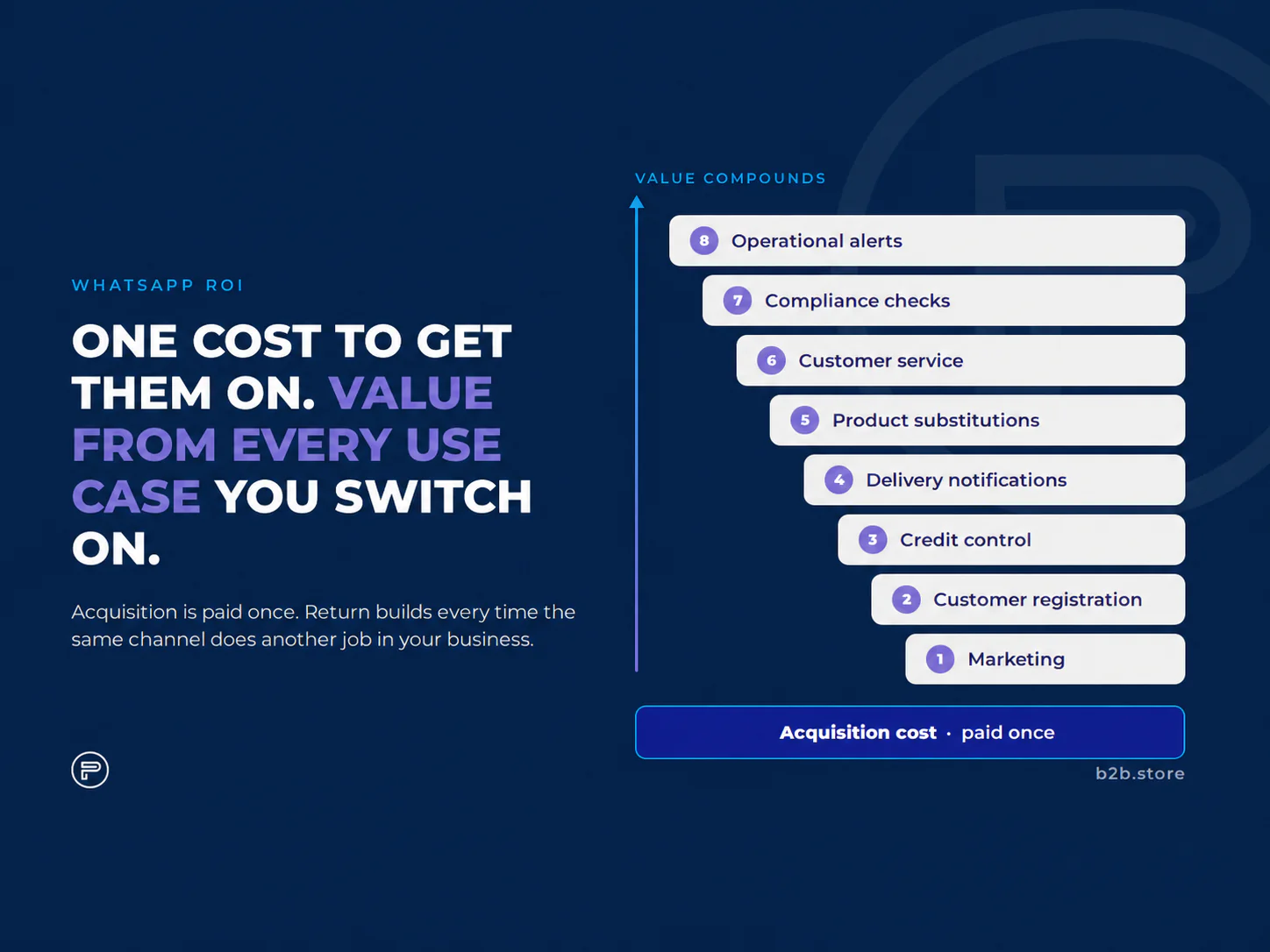
Off the top of my head, businesses in our world are using it for marketing (increasingly AI-powered, personalised marketing rather than blanket broadcasts), new customer registration and client acquisition, event registration, surveys, operational alerts, product recalls, managing product substitutions, credit control and payment reminders, delivery notifications, telling a customer when goods can’t be fulfilled, customer service and general enquiries, compliance checks, and all of it in whatever language the customer happens to speak.
Every one of those has an ROI value in any given business. Some of them are big, some are small, but they all add up, and they all sit on the same channel.
This is why the “cost of acquiring a customer onto WhatsApp” has to be looked at alongside everything you’re going to do with that customer once they’re there. If you only use WhatsApp for marketing, it has a certain value, and you have to justify the acquisition cost against that alone. But if you use it for marketing, and for credit control, and to manage product substitutions, and to field 80% of your customer service enquiries, then the same customer, acquired once at the same cost, is now generating value in four different parts of your business.
The acquisition cost is paid once. The value compounds with every use case you switch on.
A lot of use cases lend themselves to a straightforward calculation, and this is where you should start.
Compliance checks are a good example. If you currently send someone out to physically verify a trade customer, that visit has a cost in fuel, time and wages. Doing the same check through WhatsApp costs pennies. That’s not a difficult sum.
Credit control is similar. Look at what it costs you today to chase an overdue invoice, how many touches it takes, and how many days late the average payment lands. Then look at what happens when a reminder arrives on the channel your customer actually reads, with a payment link in it. The improvement in days sales outstanding is real money, and it’s yours to measure.
Customer service follows the same logic. Every enquiry that is answered on WhatsApp, particularly where AI handles the first line, is an enquiry that didn’t tie up a phone line or an inbox. Count the enquiries, cost the time, and you have a number.
Product substitutions, delivery notifications, unfulfilled order alerts: each of these replaces a phone call, an email nobody opens, or worse, a customer finding out when the van turns up. Each one has a cost today that you can put against a much lower cost on WhatsApp.
And then there’s the other kind.
Take a simple example. Your freezers break down. You send a WhatsApp to your customers telling them not to come in for frozen today. What’s the ROI on that message?
On paper it looks like a negative. Your customer isn’t buying from you. They may well go to your competitor for the day. But they haven’t wasted precious time driving to your depot to discover that your freezers aren’t working. You told them. And the respect you earn from that message is real, even though it doesn’t show up on any spreadsheet that week.
Or take a customer who sends you a query in a foreign language at two o’clock in the morning and gets a proper answer straight back. How do you put a monetary value on that? It’s difficult. But nobody who runs a business would tell you it isn’t adding value.
The honest position is this: you are going to get aspects of value that are easy to quantify, and you are going to get aspects that aren’t. The mistake is to pretend the second category doesn’t exist, or to pretend it’s worth nothing because you can’t put a number on it. Trust, loyalty and being the supplier who is easiest to deal with are the things that decide where a customer’s spend goes over the next five years. They just don’t arrive as a line item.
If you’re trying to build the case for WhatsApp in your business, I’d suggest keeping it simple.
Start by listing every use case you could realistically run on the channel, not just the one that prompted the conversation. Be generous; the list is usually longer than people expect.
Then split the list in two. For the use cases where you can count the value, do the sum: what it costs you today, what it would cost on WhatsApp, and what changes in the outcome (faster payment, fewer failed deliveries, fewer calls). For the ones you can’t count, write them down anyway and be clear about what they’re doing for you.
Set the total against the cost of getting your customers onto the channel in the first place. And remember that the cost side is largely fixed while the value side grows every time you add another use case. A business that only ever uses WhatsApp for marketing is leaving most of the return on the table.
WhatsApp in business is still relatively new for most companies. The instinct that led the early adopters to it was sound. But instinct got us this far, and the next stage needs a clearer view of what the channel costs and what it gives back. The good news is that once you look at it use case by use case, the answer is usually a lot more compelling than the marketing-only view suggests.
ProConnect is B2B.store’s WhatsApp-first customer engagement platform for wholesalers and brands. If you’d like to talk through what the numbers might look like for your business, get in touch.
Offices 13 B & C, Innovation Centre, Warwick CV34 6UW, UK
Email: hello@b2b.store • Tel: +44 (0)1926 298867
© 2026 B2B Store • Company No. 03956929